

empty
 
 
19.05.2026 03:04 PM
UK labor market weakness weighs on pound, but Middle East risk remains dominant

The pound should arguably have fallen more sharply after the latest UK labor market figures, but it did not. There are reasons for that, and they point to what comes next.

This image is no longer relevant

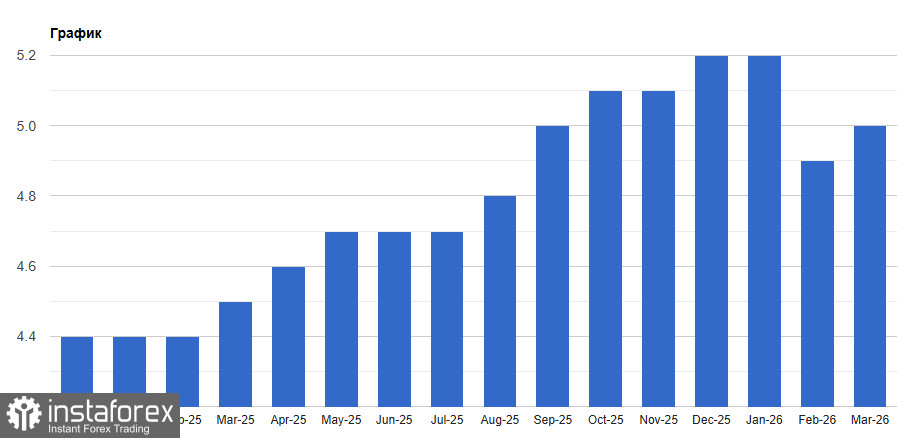
According to the Office for National Statistics, the UK labor market is cooling. Joblessness rose to 5.0% for the January–March 2026 period, above market expectations and up from 4.9% in February. In absolute terms the number of unemployed fell by 77,000 to 1.806 million—mainly reflecting a reduction in short-term unemployment—but on a year-on-year basis unemployment rose by 192,000 across all duration bands.

For context, unemployment was 4.4% at the start of 2025. Since then, it has climbed 0.6 percentage point—a slow but steady trend of labor market cooling that has intensified since the outbreak of war with Iran in late February 2026.

Annual regular pay growth for January–March 2026 stood at 3.4% excluding bonuses and 4.1% including bonuses. That is an important signal. Regular pay growth of 3.4% is the weakest since late 2020. Public sector wages continue to outpace private sector pay: public pay rose by about 5%, while private sector pay increased by 3.2%.

That is a critical point for the Bank of England. With consumer price inflation (CPI) at 3.8% year-on-year, 3.4% nominal pay growth implies a fall in real incomes. That gap is the bank's principal policy concern: inflation is rising while wages lag, risking a sharp contraction in consumer demand.

Yet the pound's decline was muted rather than dramatic. The reason is that the market recognizes the labor figures as only one factor, and not the dominant one. The primary driver of GBP/USD remains the Strait of Hormuz and developments in the Middle East.

This image is no longer relevant

Fundamentally, the United Kingdom is a net energy importer, which weighs on sterling: in March, immediately after the start of the Middle Eastern conflict and the closure of the Strait of Hormuz, GBP fell 1.9 percent. Hopes for a diplomatic resolution then triggered a reversal and pushed GBP/USD back above 1.3500. That reflects today's market hierarchy: labor market data are background noise; geopolitics send the main signal. That was confirmed yesterday, when President Trump announced the cancellation of a planned strike on Iran following calls from the leaders of Saudi Arabia, Qatar, and the UAE, prompting a sharp rise in demand for risk assets.

The upshot is clear: as long as the Strait of Hormuz remains closed, the UK economy will continue to suffer shocks; inflation will accelerate while depressing consumer demand and business activity; and now, on top of that, the labor market has started to show strain.

Ringkasan
Urgensi
Analitik
Maxim Magdalinin
Mulai berdagang
Dapatkan keuntungan dari perubahan nilai mata uang kripto dengan InstaForex.
Unduh MetaTrader 4 dan buka perdagangan pertama Anda.
  • Grand Choice
    Contest by
    InstaForex
    InstaForex always strives to help you
    fulfill your biggest dreams.
    GABUNG KONTES
  • Chancy Deposit
    Isi akun Anda sebesar $3000 dan dapatkan $9000 lebih banyak!
    Pada Mei kami mengundi $9000 dalam promo Chancy Deposit!
    Dapatkan kesempatan untuk menang dengan melakukan deposit sebesar $3000 pada akun trading Anda. Setelah memenuhi persyaratan ini, Anda telah menjadi partisipan promo.
    GABUNG KONTES
  • Trade Wise, Win Device
    Top up akun anda dengan dana minimal $500, daftar kontes, dan dapatkan peluang untuk memenangkan perangkat seluler.
    GABUNG KONTES
  • 30% Bonus
    Raih bonus 30% setiap kali anda top up
    DAPATKAN BONUS

Artikel yang direkomendasikan

Tidak bisa bicara sekarang?
Tanyakan pertanyaan anda lewat chat.
Widget callback